TU Delft Selection Exam: Strategies to Maximize Your Score

The Selection Exam determines 60% of your final ranking for TU Delft Aerospace Engineering. With 90 minutes to answer approximately 70 multiple-choice questions across three sections, time pressure is intense.
This guide covers proven strategies for each section and general tactics that can significantly improve your score.
Exam Structure
Key rules
- All multiple choice
- No penalty for wrong answers
- Sections must be completed in order
- You cannot return to a previous section
- Calculator: computer's built-in calculator app only, standard/scientific mode (no graphing, no online calculators)
The Fundamental Strategy: Two-Pass Method
With ~90 seconds per question on average, you cannot afford to get stuck. The two-pass method ensures you maximize points:
First Pass: Harvest the Easy Points
Go through every question in the section. For each question:
- If you immediately know how to solve it → solve it, mark your answer, move on
- If you need more than 30 seconds to figure out the approach → mark an answer (your best guess), note the question number, move on
Why mark an answer before skipping? There's no penalty for wrong answers. A guess gives you 25% chance. An empty answer gives you 0%. If you run out of time, at least everything has an answer.
Keep a tracking sheet. Use scratch paper to track:
- Questions answered confidently: ✓
- Questions guessed, need to return: ?
- Questions skipped entirely: X
Second Pass: Work the Uncertain Ones
With remaining time, return to questions you marked. Prioritize:
- Questions where you had some idea but needed more time
- Questions where you can eliminate options
- Complete unknowns (if time remains)
Final Minute Check
Always reserve the last 60 seconds to verify every question has an answer selected. Don't let the timer run out with blanks.
Multiple Choice Strategies
Since every question is multiple choice, these techniques can save time and rescue questions you don't know how to solve directly:
1. Elimination
Before calculating, look at the options. Can you immediately eliminate any?
- Negative when the answer must be positive?
- Way too large or small?
- Wrong units or format?
Eliminating even one option improves your odds from 25% to 33%. Eliminating two gives you 50%.
2. Work Backwards
For some problems, especially integrals, checking answers is faster than solving.
Example: If asked to find ∫f(x)dx and you see four options, take the derivative of each option. The one that gives you f(x) is correct.
This technique transforms a hard integral into four easy derivatives.
3. Plug In Numbers
For abstract problems with variables, substitute simple numbers (0, 1, 2, -1) and see which answer matches.
Example: If asked which expression equals f(x) for all x, plug in x=1 to your expression and each answer. Eliminate any that don't match.
4. Estimate First
Before detailed calculation, estimate the answer. This helps you:
- Catch calculation errors (if your answer is nowhere near your estimate)
- Eliminate obviously wrong options
- Make educated guesses when stuck
5. Check Extremes
For questions about functions or physical systems, consider extreme cases:
- What happens as x → 0? As x → ∞?
- What happens at maximum/minimum points?
Often only one answer behaves correctly at extremes.
Mathematics Section
Students consistently find this the hardest section. Here's what to focus on:
High-Priority Topics:
- Functions: recognizing types (polynomial, logarithmic, exponential, trigonometric), transformations, domains, asymptotes
- Differential calculus: derivatives using chain rule, product rule, quotient rule; finding maxima/minima
- Integral calculus: standard integrals, substitution, definite integrals, area calculations
Also Important:
- Trigonometry: unit circle, identities, solving trig equations
- Geometry: areas, volumes, lines, circles
- Vectors: dot product, angles, projections
Math-Specific Tips:
For derivatives: Know your standard derivatives cold. Chain rule comes up constantly — practice until it's automatic.
For integrals: The "work backwards" trick is especially powerful here. If you see a nasty integral, differentiate the answers instead.
For functions: Practice rapid function recognition. When you see f(x) = ..., you should immediately know its general shape, asymptotes, and behavior.
For optimization: These problems follow a pattern — set derivative to zero, solve, verify it's max or min. Practice the pattern.
Common Time Traps:
- Long algebraic simplification → estimate or check answers instead
- Complicated integrals → differentiate the options
- Systems of equations → look for shortcuts before grinding through
Physics Section
Students find this medium difficulty. Focus areas:
High-Priority Topics:
- Mechanics: Newton's laws, kinematics (motion equations), friction
- Energy: kinetic, potential, conservation of energy, work-energy theorem
- Oscillations: pendulums, springs, simple harmonic motion
Also Important:
- Electric circuits: Ohm's law, series/parallel, power
- Magnetic fields: Lorentz force, induction basics
- Waves: frequency, wavelength, wave speed
Physics-Specific Tips:
Energy methods are often faster. Many mechanics problems can be solved two ways: forces (Newton's laws) or energy (conservation). Energy methods are usually quicker and less error-prone.
Example: "A ball rolls down a frictionless ramp. What's its speed at the bottom?"
Force method: Find acceleration, use kinematics, multiple steps.Energy method: mgh = ½mv² → v = √(2gh). One equation.
Draw diagrams. For mechanics problems, a quick sketch clarifies which forces act where. 30 seconds drawing saves 2 minutes of confusion.
Check units. If your answer has wrong units, it's wrong. This catches errors and can eliminate options.
Watch for g = 10 approximations. The exam may use g = 10 m/s² for cleaner numbers. Check what value they give.
First-Year AE Topics Section
Students find this the easiest, if they've studied. It's the highest-weighted section (40%) and the most straightforward: learn the material, answer the questions.
The 2026 Syllabus Covers:
Aerospace Structures and Materials (Chapter 5 of the textbook)
- Airframe design and structural concepts
- Fuselage and wing structures
- Torsion box
- Spacecraft and launch vehicle structures
Aerodynamics
- How aircraft fly
- Fundamentals of aerodynamics
- Continuity equation, flow types
- Lift, drag, moment coefficients
Flight Mechanics
- Introduction to flight mechanics
- Equations of motion
- Thrust, power required, altitude effects
- Rate of climb, gliding flight
Space
- Launch vehicles
- Orbits
First-Year Topics Specific Tips:
Know the formulas and their assumptions. TU Delft explicitly states you must know formulas by heart, including what assumptions they're based on.
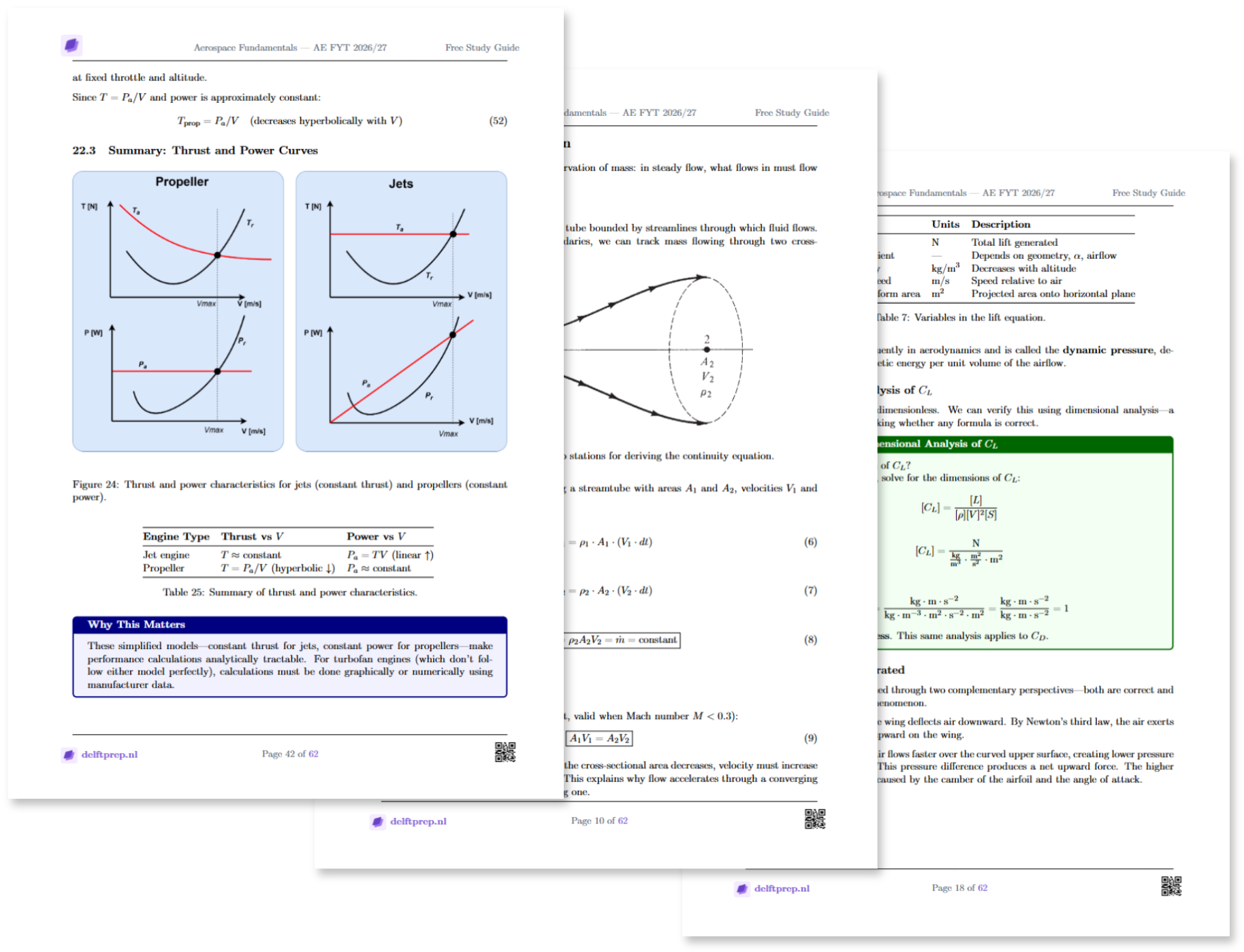
Understand the graphs. Many FYT questions involve interpreting graphs — lift vs. angle of attack, drag polars, thrust vs. velocity, etc. Know what each axis represents, what the shape of the curve tells you, and how changes in conditions shift the curves.
Watch the video lectures carefully. All 17 videos are examinable. Don't just skim them.
Understand, don't just memorize. Questions test whether you can apply concepts, not just recall definitions. If you see a graph you haven't seen before, you should be able to reason about it using the principles you've learned.
This section rewards preparation. Unlike math where you might encounter an unfamiliar problem type, FYT is bounded by the syllabus. Study everything thoroughly, and you'll recognize everything on the exam.
Calculator Usage
You may only use your computer's built-in calculator app in standard or scientific mode:
- Windows: Windows Calculator (search "Calculator" in Start menu)
- macOS: Calculator app (in Applications or Spotlight search)
- Linux: Your distribution's default calculator (e.g., GNOME Calculator)
Graphing mode, programming mode, statistics mode, online calculators, and calculator websites are not allowed.
Practice with your calculator before exam day. This is important — you don't want to waste precious seconds during the exam figuring out how to calculate sin(37°) or find a square root.
Before the exam:
- Locate your computer's calculator app
- Practice switching between standard and scientific mode
- Know how to do: powers, square roots, trig functions (sin, cos, tan), logarithms
- Do a few timed practice problems using only this calculator
Students who practice with their system calculator beforehand are noticeably faster on exam day.
Week Before the Exam
Days 7-5: Content review. Go through each topic area. Identify weak spots.
Days 4-3: Focused practice on weak areas. Do timed practice problems.
Days 2-1: Full timed practice exams. Simulate real conditions — no breaks, no phone, calculator only.
Day 0 (exam day):
- Get good sleep the night before
- Eat a proper meal
- Set up your space: quiet, well-lit, computer charged and plugged in
- Have scratch paper and pen ready
- Test your webcam, microphone, and internet connection
- Start the system check early, don't leave it to the last minute
What DelftPrep Offers
TU Delft now provides official practice questions, approximately 15 per subject. These are essential for understanding the format, but not enough to build the speed and strategy instincts you need for exam day.
DelftPrep offers 500+ exam-style questions designed specifically for this selection test:
- 250+ Mathematics questions: including problems that reward the strategies covered in this guide: working backwards, elimination, estimation, and checking extremes
- 130+ Physics questions: covering mechanics, energy, oscillations, circuits, and waves
- 130+ First-Year Topics questions: updated to the 2026/27 syllabus
- Timed and untimed practice modes to build speed under pressure
- Detailed worked solutions showing both the direct method and strategic shortcuts
The strategies in this guide only become instinctive through repetition. Our questions give you the practice needed to recognise when to calculate, when to estimate, and when to work backwards.
Explore more

Complete TU Delft Aerospace Selection Guide 2026/27

TU Delft Costs: A Student's Guide

Understanding the Ranking System of the Entrance Exams
Free First-Year Topics Study Guides